Create Account
Manage my channels
Watch later and create collections
Manage your email subscriptions
Exclusive offers and opportunities
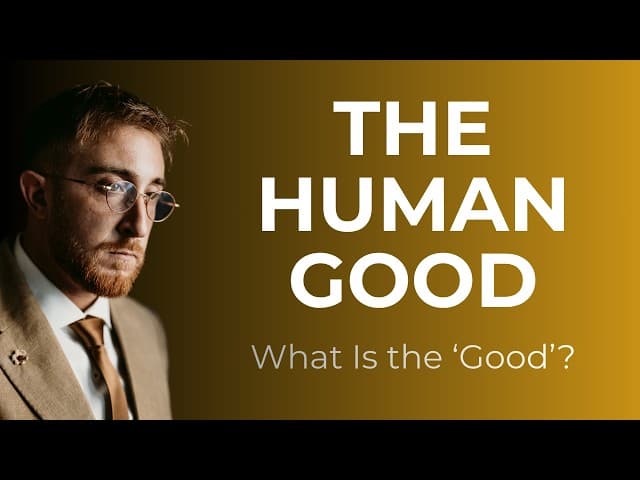
What is the good—and how does a society lose it?
In this episode, we turn to chapter two of Bernard Lonergan’s Method in Theology, where the question of method gives way to the question of the human good.
Once we understand that consciousness moves from experience to understanding, from understanding to judgment, and from judgment to decision, a deeper question immediately follows:
Decision for what?
Judgment about what good?
Responsibility ordered toward what end?
Lonergan’s answer is unsentimental and concrete. The good is never a vague abstraction hovering above life. The good is always concrete—embedded in persons, actions, skills, feelings, judgments, institutions, cooperation, and history.
That is why this chapter begins, unexpectedly, with skill. Human flourishing is not wished into existence. It depends upon developed capacities, learned operations, and the mediated world of language, symbol, memory, promise, and law. Human beings do not live by immediate satisfactions alone. We live in a world shaped by meaning.
From there, Lonergan turns to feelings, not as irrational leftovers, but as intentional responses that give consciousness its mass, momentum, and drive. He insists that not all feelings are alike, and that the merely agreeable is not the same as the truly good. That distinction opens into his scale of values: vital, social, cultural, personal, and religious.
The episode then develops one of Lonergan’s most important claims: that value is a transcendental notion. We are always already asking whether something is really worthwhile, whether it is truly good or only apparently good. And that leads to the crucial distinction between the apprehension of value and the judgment of value.
But Lonergan does not stop at individual moral decisions. He moves into the social structure of the good itself: particular goods, the good of order, institutions, liberty, personal relations, and the difference between originating values and terminal values.
Finally, the chapter culminates in a stark account of progress and decline. Societies flourish when persons live attentively, intelligently, reasonably, and responsibly. They decay when bias, egoism, and rationalization corrode institutions from within. Decline is not merely something that happens to a civilization. It is something a civilization can cooperate in producing.
Chapters
00:00 — The question of the good
01:32 — Why the good is always concrete
03:18 — Skill and the formation of human capacity
05:04 — Mediation and the world shaped by meaning
06:42 — Feelings and moral orientation
08:36 — The agreeable and the truly good
10:02 — The scale of values
12:04 — Value as a transcendental notion
13:42 — Apprehension and judgment of value
15:24 — Belief and the social structure of knowing
16:52 — Particular goods and the good of order
18:46 — Liberty, self-transcendence, and originating value
20:16 — Personal relations, community, and conflict
21:32 — Progress and decline
22:44 — Why theology needs the human good
Theology cannot speak meaningfully about grace, sin, conversion, or redemption unless it can first speak intelligibly about the human good that grace heals, sin damages, conversion reorders, and redemption restores.
In the next episode, we move to meaning—to the symbols, language, art, and cultural forms through which the human world is actually mediated.
How do we recover meaning in a fragmented world?
Short reflections on consciousness, conversion, and responsibility.
Read the full essays at Mediated by Meaning: https://mediatedbymeaning.substack.com
#meaning #philosophy #faith #psychology #jordanpeterson #catholic #lonergan #selfunderstanding