08:48
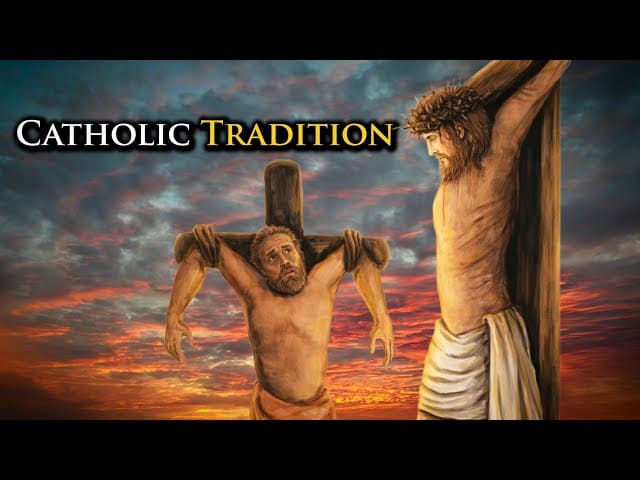
The Legend of Saint Dismas
The Catholic Men's Podcast | 6 days ago
The depravity of Luther's error knew no bounds, even to the extent that at times, he thought he was God. This and many other shocking facts were brought to my attention by an article written by the great Brazilian Catholic thinker, Plinio Corrêa de Oliveira, titled “Luther Thought He Was Divine” which I will recount on for you today. Here's the article: https://www.pliniocorreadeoliveira.info/UK_19840110_LutherThoughtHeWasDivine.htm
Keep in mind, I simplified some of the author's introduction for younger listeners.
Here are the Martin Luther quotes and sources:
He wrote to a friend that a man vexed by the Devil should occasionally “drink more abundantly, gamble, entertain himself, and even commit some sin out of hatred and spite for the Devil so that we may not give him an opportunity to disturb our consciences with trifles. The whole Decalogue should be erased from our eyes and our souls, from us who are so persecuted and molested by the Devil” (M. Luther, Briefe, Sendschreiben und Bedenken, Ed. De Wette [Berlin, 1825-1828]; Franca, pp. 199-200).
Along the same line he also wrote: “God only obliges you to believe and to confess (the faith). In all other things He leaves you free, lord and master to do whatever you will without any danger to your conscience; on the contrary, it is certain that, as far as He is concerned, it makes no difference whether you leave your wife, flee from your lord, or are unfaithful to every obligation. What is it to Him if you do or do not do such things?” (Werke, Weimar ed., XII, pp. 131 ff.; Franca, p. 446).
The incitement to sin given in a letter to Melanchton on August 1, 1521, is perhaps even more categorical: “Be a sinner, and sin strongly (esto peccator et pecca fortiter), but believe and rejoice even more firmly in Christ, the conqueror of sin, of death, and of the world. During this life, we have to sin. It is sufficient that, by the mercy of God, we know the Lamb who takes away the sins of the world. Sin will not separate us from Him, even though we were to commit a thousand murders and a thousand adulteries per day” (Briefe, Sendschreiben und Bedenken, II, p. 37; Franca, p. 439).
“There is no religion in the whole world that teaches this doctrine of justification; I myself, even though I teach it publicly, have a great difficulty in believing it privately” (Werke, XXV, p. 330; Franca, p. 158).
Luther himself recognized the devastating effects of his admittedly insincere preaching, saying: “The Gospel today finds adherents who are convinced that it is nothing but a doctrine that serves to fill their bellies and give free reign to all their impulses” (Werke, XXXIII, p. 2; Franca, p. 440).
And Luther added, regarding his evangelical henchmen, that “they are seven times worse than they were before. After the preaching of our doctrine men have given themselves up to robbery, lying, imposture, debauchery, drunkenness, and every kind of vice. We have expelled one devil (the papacy), and seven worse ones have come in” (Werke, XXVIII, p. 763; Franca, p. 441).
“After we understood that good works are not necessary for justification, I became much more remiss and cold in doing good...and if we could return now to the old state of things and if the doctrine of the necessity of good works to be holy could be revived, our alacrity and promptness in doing good would be different” (Werke, XXVII, p. 443; Franca, p. 443).
All these insanities make it understandable how Luther reached a frenzy of satanic pride, saying of himself: “Does this Luther not appear to you to be eccentric? As far as I am concerned, I think he is God. Otherwise, how could his writings or his name have the power to transform beggars into lords, asses into doctors (of learning), falsifiers into saints, slime into pearls!” (Werke, Ed. Wittenberg, 1551, IV, pp. 378; Franca, p. 190).
At other times, Luther’s opinion of himself was much more objective: “I am a man exposed to and involved in society, debauchery, carnal movements, in negligence and other disturbances, to which are added those of my own office” (Briefe, Sendschreiben und Bedenken, I, p. 232; Franca, p. 232).
Excommunicated in Worms in 1521, Luther gave himself up to idleness and sloth. On July 13 of that year he wrote to Melanchton: “I find myself here insensate and hardened, established in idleness. Oh, woe! Praying little, and ceasing to moan for the Church of God, because my untamed flesh burns in great flames. In short, I, who ought to have the fervor of the spirit, have the fervor of the flesh, of licentiousness, sloth, idleness, and somnolence” (Briefe, Sendschreiben und Bedenken, II, p. 22; Franca, p. 198).
In a sermon preached in 1532: “As for me I confess, and many others could undoubtedly make an equal confession, that I am careless of discipline and zeal. I am much more negligent now than under the papacy; no one has ardor for the Gospel now like that you used to see” (Saemtiliche Werke, XVII , p. 353; Franca, p. 441).